Wednesday, October 14, 2026

Robots Get Their Frontier API

Robots Get Their Frontier API

Today’s Overview

Good morning, robotics models are getting a hosted API moment, Anthropic is rethinking source control for AI-speed coding, and Google is pushing Gemini 4 Argon deeper into enterprise work. There is also a strong research thread on faster decision-native agents, from reflective tool use to video understanding. Let's dive in.

Top Stories

Physical Intelligence opens Pi API beta

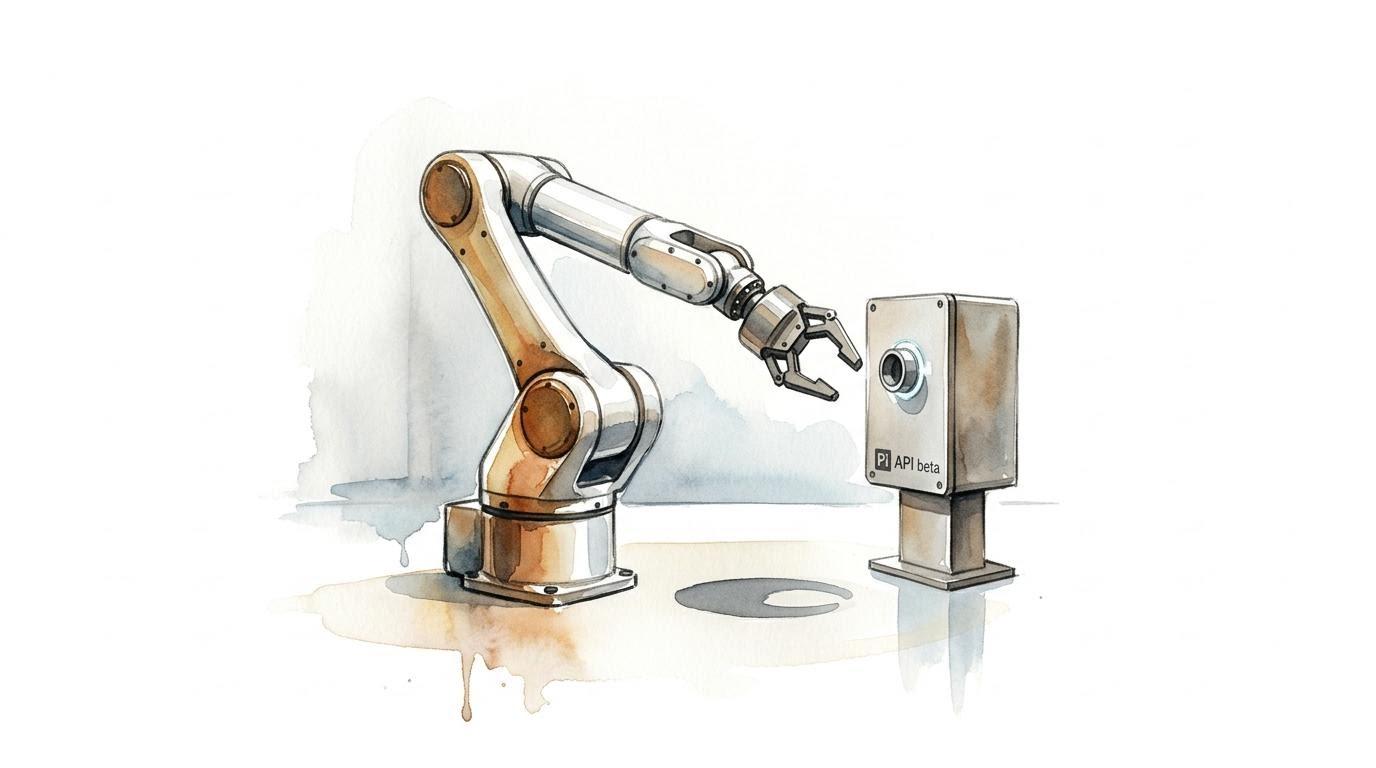
Physical Intelligence is making its latest robotic foundation models available for training and inference through the Pi API beta. The pitch is simple: developers upload robot data, fine-tune on managed infrastructure, and run inference through a hosted gateway instead of building the full ML stack themselves.

  • The beta is framed around adapting general robotic foundation models to new tasks and hardware with less data and engineering effort.
  • Early examples span industrial, food, manufacturing, and robotics labs rather than a single controlled demo category.
  • The iteration loop is explicit: collect demonstrations, train, test on the robot, then use failures to guide the next data collection pass.

Anthropic rebuilds source control for AI-scale coding

Anthropic built Scion after Claude-driven development pushed its monorepo beyond what its Git setup could comfortably support. The company says daily merges climbed from 2,500 in May to more than 30,000 in September, while Scion cut CPU and memory usage by roughly 200x and reduced checkout times from minutes to seconds.

  • Anthropic says its main branch history alone reached almost 100 GB with a compressed working copy over 25 GB.
  • The old setup involved several hundred internal Git mirrors before scaling pressure made that approach harder to operate.
  • Scion is built around online clients, server-side operations, sparse checkouts, and horizontally scalable caches rather than full local repository copies.

Gemini 4 Argon arrives on Google Cloud

Google made Gemini 4 Argon available on Google Cloud as a frontier model for long, multi-step enterprise work. It is positioned for tasks that need sustained context and domain expertise, including software development, finance, legal work, and cybersecurity.

  • Google describes Argon as trained for depth and precision across long workflows.
  • The model is meant to handle inputs mixing text, tables, charts, and images and return a grounded output.
  • Google says Argon is designed to respect system boundaries, report negative findings, and ask for confirmation before irreversible steps.

Research & Analysis

Agent-Reflex trains agents to recover from noisy tools

Agent-Reflex is a three-stage framework for teaching language agents to reflect, recover, and respond to user corrections. Built on Qwen3-8B, it reports a 58.6 overall score across five long-horizon tool-use benchmarks and 29.1 on AgentNoiseBench while improving robustness to noisy interactions.

  • The paper targets real deployments where MCP tool services may timeout or return errors and users may interrupt with corrections.
  • Its skill discovery stage injects tool-feedback perturbations into 557 MCP environments to mine reflection behavior.
  • The authors say they distilled 1,170 reflection meta-skills from matched success and failure contrasts.

Jeva makes fast decisions from first principles

Jeva is a decision-native architecture for structured decision tasks rather than free-form text generation. It jointly addresses null awareness, permutation invariance, option scalability, and cacheability, with reported strong typed-decision performance and no decision flips under tested permutations.

  • The paper argues that serialized text prediction does not automatically preserve decision problem structure.
  • Jeva uses a separate coverage estimate so the model can distinguish answer absence from uncertainty among candidates.
  • The submitter says the 4B model handles 2,048 candidates and delivers over 20x median-latency speedups with fully pre-cached long-document candidates.

Urbex turns city-scale grounding into active search

Urbex is an agentic vision-language framework for grounding objects in city-scale 3D scenes. Instead of ranking precomputed proposals, it lets a VLM agent explore an interactive multi-view environment and commit a grounded bounding box.

  • The core shift is from candidate ranking to active spatial search in large outdoor scenes.
  • The agent can query landmarks, zoom into local regions, and render oblique views before making a final localization decision.
  • The authors made the code, model, data, and Colab demo public for follow-up work.

VideoJev speeds up video understanding decisions

VideoJev recasts video understanding and interaction as structured decision tasks. It replaces autoregressive answer decoding with a shared head that scores temporal intervals and answer choices against video evidence, reporting stronger temporal grounding and large inference speedups.

  • The model family includes 4B and 35B-A3B variants for video understanding and interaction.
  • Cached inference supports new questions as they arrive, while joint inference can answer multiple questions in one forward pass.
  • Training and evaluation code plus both model checkpoints are described as available for the release.

Trending AI Tools

  • Drama 3 An open-weight TTS model with script-level controls for tone, pacing, emotion, multilingual switching, and self-hosted or API use.

  • Gemini 4 Argon Google opened access in the Gemini app, Search AI Mode for Pro and Ultra users, and developer APIs.

  • Microsoft-Decision-1 A hosted decision-scoring model in Microsoft Foundry and OpenRouter that returns calibrated probabilities for fixed-answer tasks.

Quick Hits

Keep reading for free

Enter your email. If you're already subscribed, we'll send a sign-in code. If not, you'll subscribe in the next step.

Free access. Subscribe once, then use the same email on future issues.

Free to read. Subscription just unlocks the full issue.