Wednesday, July 15, 2026

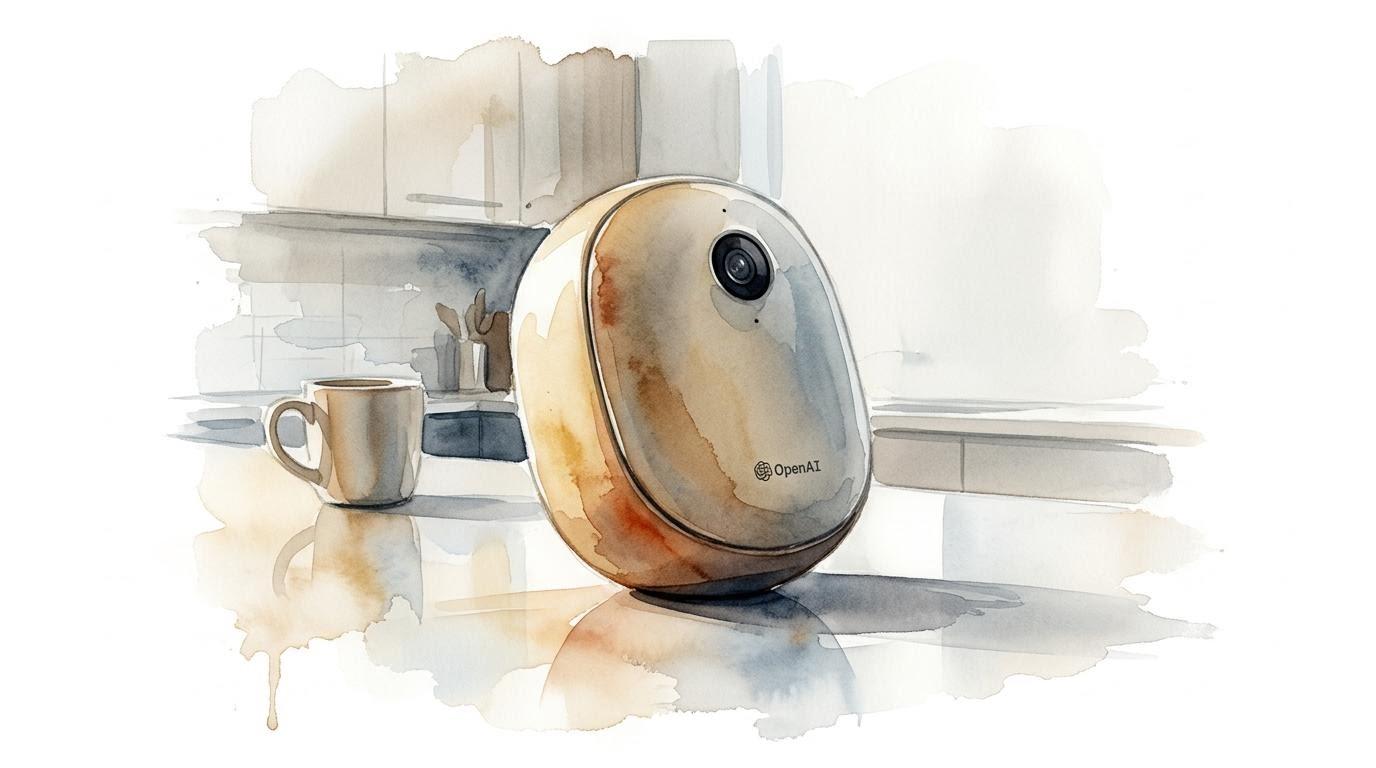
OpenAI’s Speaker Starts Moving

OpenAI’s Speaker Starts Moving

Today’s Overview

Good morning, AI hardware is getting weirdly physical, with OpenAI’s first device reportedly taking shape as a screen-free companion for the home. Meanwhile, Demis Hassabis is pushing for frontier-model safety checks before release, and researchers are finding sharper ways to make coding agents understand repositories before they patch them. Let’s dive in.

Top Stories

OpenAI’s First Device Looks Like a Moving Smart Speaker

OpenAI’s first hardware product is reportedly taking shape as a removable, screen-free smart speaker with a camera and sensors. Built with Jony Ive’s design firm LoveFrom, the device is meant to act as a humanlike AI companion for cooking, chores, media, messaging, smart home control, and productivity. The broader roadmap includes roughly five AI hardware products, but Apple’s trade-secret lawsuit could slow the rollout and force engineers into defense mode.

  • The device is being pitched internally as a home-based AI companion rather than a phone or conventional display product.
  • Its design reportedly includes mechanical movement to make ChatGPT feel like a more physical presence.
  • The hardware push arrives as consumer AI devices are attracting major funding before many products have reached customers.

Demis Hassabis Calls for a U.S. AI Watchdog

Google DeepMind CEO Demis Hassabis laid out a plan for a U.S.-led oversight body that would safety-test advanced AI models before public release. The proposal would review models based on capability rather than where or how they are deployed, with frontier labs voluntarily submitting models 30 days ahead of launch. Hassabis wants the body running this year and says it should be able to coordinate a slowdown among frontier labs if needed.

  • The model is drawn from FINRA-style self-regulation rather than a traditional government agency structure.
  • The proposed reviews would test for deception and dangerous misuse including bioweapons creation and malicious hacking skills.
  • A key concern is that open-source capabilities could reach dangerous territory within 18 months.

Anthropic Funds Canadian AI Research With Claude Credits

Anthropic is committing $10 million CAD in Claude API credits across eight Canadian research institutions. Each institution will receive $1 million in credits, and Anthropic says it will not control research directions or findings. Amii, Mila, and Vector Institute are also joining Anthropic for Startups, giving affiliated startups at least $5,000 USD in API credits each.

  • The partnerships span AI institutes and health centers including Amii, Mila, Vector, CHEO, CAMH, Université Laval, University of Saskatchewan, and University of Toronto.
  • Anthropic says the credits will support beneficial and responsible applications across research, hospitals, and universities.
  • Its Canadian usage snapshot says Canada ranks eighth worldwide in Claude.ai use and second among top countries by per-capita overrepresentation.

Research & Analysis

ACQUIRE Helps Coding Agents Learn Repos Before Fixing Bugs

ACQUIRE tackles a stubborn problem in LLM-based software repair: agents often patch code without enough repository understanding. The framework separates knowledge acquisition from patch generation, using a Questioner and Answerer to build structured, evidence-grounded repository knowledge before a Resolver generates the fix. On SWE-bench Verified, the method improves Pass@1 by up to 4.4 percentage points while adding only modest cost and time.

  • The method replaces unguided pre-repair exploration with targeted questions about repository behavior.
  • The Answerer performs autonomous exploration to ground responses in evidence before patching begins.
  • The authors frame the gain as coming from explicit knowledge gaps being surfaced and resolved before code changes are attempted.

Anthropic Maps How Claude’s Behavior Shifts by Model and Language

Anthropic analyzed 309,815 real Claude conversations across three models and the top 20 languages on Claude.ai. The study compressed more than 3,300 values into four behavioral axes: deference vs. caution, warmth vs. rigor, depth vs. brevity, and candor vs. execution. Anthropic says the framework could help detect unintended behavior shifts before future models ship, but it does not yet know why the differences appear or whether they are desirable.

  • The four axes explain 15% of value variance after controlling for task, topic, and user-expressed values.
  • The dataset came from two weeks in May 2026 across real Claude conversations.
  • Anthropic says future work could connect value profiles to user outcomes such as trust, wellbeing, or decision quality.

SpectraReward Turns Multimodal Models Into Image Rewards

SpectraReward is a training-free reward function for text-to-image reinforcement learning. It scores a generated image by measuring how well a pretrained multimodal model can recover the original prompt from that image, avoiding preference labels or reward-model fine-tuning. The paper also introduces Self-SpectraReward, where a unified multimodal model’s understanding branch rewards its generation branch.

  • The evaluation covered two diffusion models plus three reinforcement learning algorithms.
  • The reward backbones included nine multimodal models from four families ranging from 4B to 235B parameters.
  • A major finding is that bigger reward models are not always better than better-aligned reward-policy pairs.

Google Builds SensorFM for Wearable Health Data

Google Research introduced SensorFM, a foundation model trained on one trillion minutes of biometric data from Fitbit and Pixel Watch users. The model handles 34 wearable features, including heart rate, skin temperature, and motion, and is designed to fill gaps in messy real-world data. Google says it outperformed traditional models on nearly all behavioral prediction tasks.

  • The pretraining data came from five million consented participants across more than 100 countries and all 50 U.S. states.
  • SensorFM ingests five sensor modalities including PPG, accelerometry, electrodermal activity, skin temperature, and altimetry.
  • Scaling experiments found the largest model improved downstream performance by 9% on classification and 21% on regression tasks.

Trending AI Tools

  • Bonsai 27B An open-source multimodal model compressed to 3.9 GB for phone-scale, private, offline agents.

  • Claude for Teachers Free one-year premium access for verified U.S. K-12 educators, with lesson planning aligned to state standards.

  • Claude Code Browser Claude Code now has a built-in browser, while Fable 5 access and boosted usage limits continue through July 19.

Quick Hits

Keep reading for free

Enter your email. If you're already subscribed, we'll send a sign-in code. If not, you'll subscribe in the next step.

Free access. Subscribe once, then use the same email on future issues.

Free to read. Subscription just unlocks the full issue.