Friday, June 26, 2026

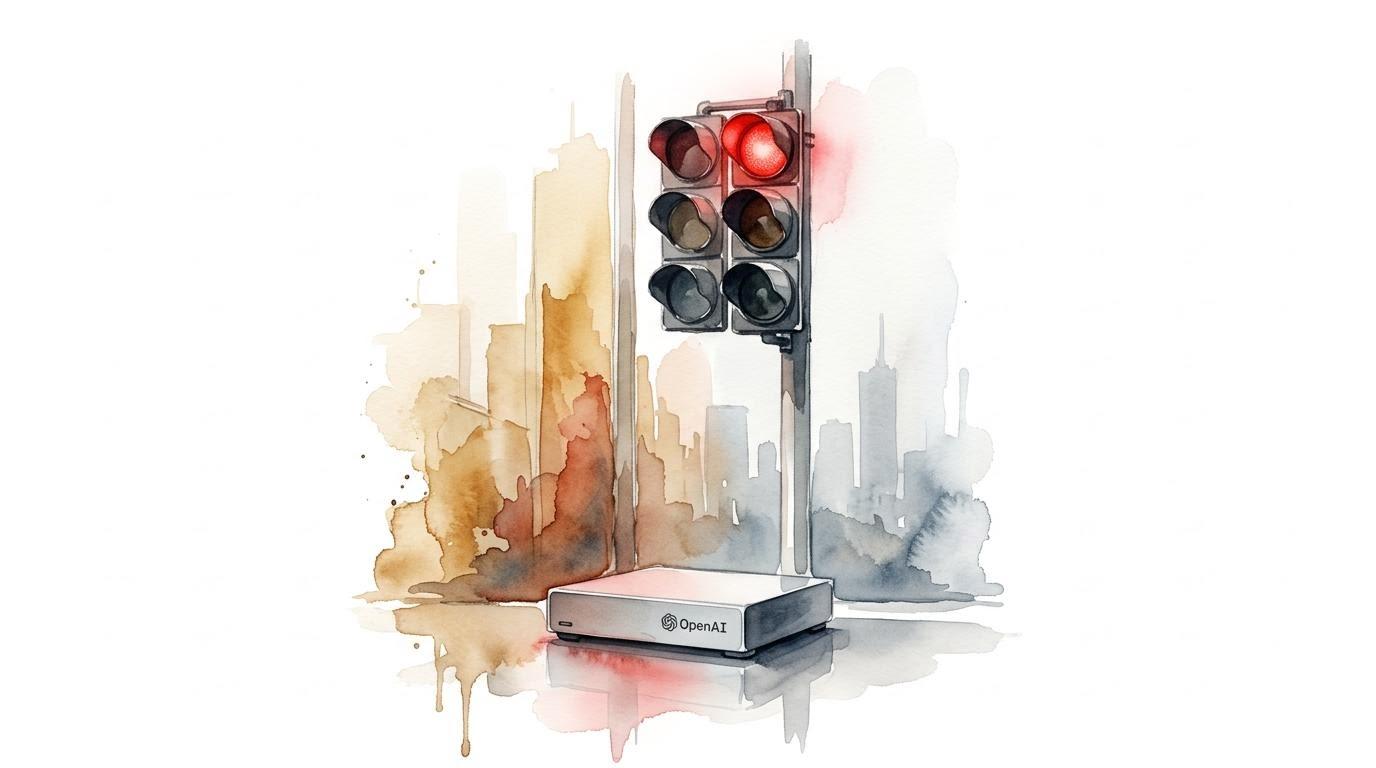
OpenAI Gets A Red Light

OpenAI Gets A Red Light

Today’s Overview

Good morning, AI’s frontier-model drama just got more political: the White House is pressing OpenAI to slow a launch, Anthropic may be inching toward a Fable 5 comeback, and Sakana is pitching orchestration as the next way around single-model dependence. Meanwhile, agent research is getting sharper and more practical. Let’s dive in.

Top Stories

White House Asks OpenAI To Slow New Model Release

The White House has asked OpenAI to delay public deployment of its next-generation frontier model over national security and structural safety concerns. Officials want a longer red-teaming window focused on cyber-capability execution limits and automated social manipulation vulnerabilities.

  • The model named in the article is GPT 5.6, with access reportedly limited to a select group of close partners first.
  • Sam Altman reportedly told staff that the government would be approving access customer by customer during the preview period.
  • The agencies cited as involved were the Office of the National Cyber Director and OSTP, signaling direct federal review of deployment decisions.

Anthropic’s Fable 5 Comeback Starts Taking Shape

Anthropic’s Fable and Mythos remain offline under the U.S. order, but several signals suggest a possible path back. Claude Code logs, White House talks, and a legal challenge are all pointing toward a potential thaw in the freeze.

  • The model went offline on June 12 after the NSA affirmed ways to disable guardrails and access restricted Mythos capabilities.
  • Recent discussions included both high-level and working-group talks with technical staff from both sides involved.
  • Lawmakers asked Commerce to define specific criteria and a timeline for restoring public access to the model.

Sakana AI Launches Fugu For Multi-Model Orchestration

Sakana AI launched Fugu, a system that coordinates multiple LLMs through a single API. The product turns multi-model agent orchestration into a simpler interface for complex, multi-step work.

  • Fugu is designed to act like one model endpoint while internally deciding whether to answer directly or assemble specialist models.
  • The launch includes Fugu and Fugu Ultra, both available through an OpenAI-compatible API.
  • Sakana says future updates will expand the expert agent pool with open models, Sakana models, and additional frontier models.

Research & Analysis

OPID Distills Skills From Agent Trajectories

OPID extracts skill supervision directly from completed on-policy trajectories for language agents. It frames hindsight as hierarchical skills and uses those skills to improve policy optimization without relying on external memories or privileged retrieved context.

  • The method keeps RL as the primary objective while adding dense, distribution-matched hindsight supervision.
  • Its experiments cover ALFWorld, WebShop, and Search-based QA rather than a single agent environment.
  • A public implementation is linked through the OPID GitHub repository from the paper page.

ViQ Compresses Visual Representations At Any Resolution

Tencent Hunyuan researchers introduced ViQ, a visual quantization framework for discrete multimodal representations. The method aims to preserve both semantic richness and low-level visual detail while supporting native-resolution inputs.

  • The visual encoder gets semantic supervision from a pretrained language model during text-aligned pre-training.
  • Discretization uses proximal representation learning to progressively compact the feature space.
  • The release points to GitHub code and Hugging Face weights for the ViQ project.

OpenAI Says Codex Use Surged Across Teams

OpenAI says internal use of Codex systems rose sharply between November 2025 and June 2026. The company frames the growth as evidence that employees are using agents for research synthesis, customer support, engineering, and legal analysis.

  • In business functions, over one-fourth of Codex work was engineering or coding, showing agents pushing non-engineers across task boundaries.
  • For finance and business operations, the largest output category was knowledge work at 34% of output tokens.
  • For product, marketing, and operations, 51% of output tokens were classified as knowledge work.

Qwen-Image-Agent Targets The Context Gap

Qwen proposes an agentic image-generation framework for prompts that are underspecified, implicit, or dependent on current knowledge. The system builds generation context through planning, reasoning, search, memory, and feedback, then evaluates those capabilities with Image Agent Bench.

  • The paper was listed as the number three paper of the day on Hugging Face.
  • IA-Bench evaluates four core capabilities: Plan, Reason, Search, and Memory for image-generation agents.
  • The experiments include Mindbench and WISE-Verified alongside IA-Bench.

Trending AI Tools

  • Codex Record and Replay Records a user completing a computer task, uploads it as a skill, and lets Codex repeat the steps autonomously.

  • Grok in T3code Lets users connect SuperGrok or X Premium+ credentials and use Grok as a coding agent without an API key.

  • Hermes Pet Sprites Adds animated agent-state pets to Hermes agents across GUI and terminal interfaces, with nearly 3,000 options.

Quick Hits

Keep reading for free

Enter your email. If you're already subscribed, we'll send a sign-in code. If not, you'll subscribe in the next step.

Free access. Subscribe once, then use the same email on future issues.

Free to read. Subscription just unlocks the full issue.