Friday, November 13, 2026

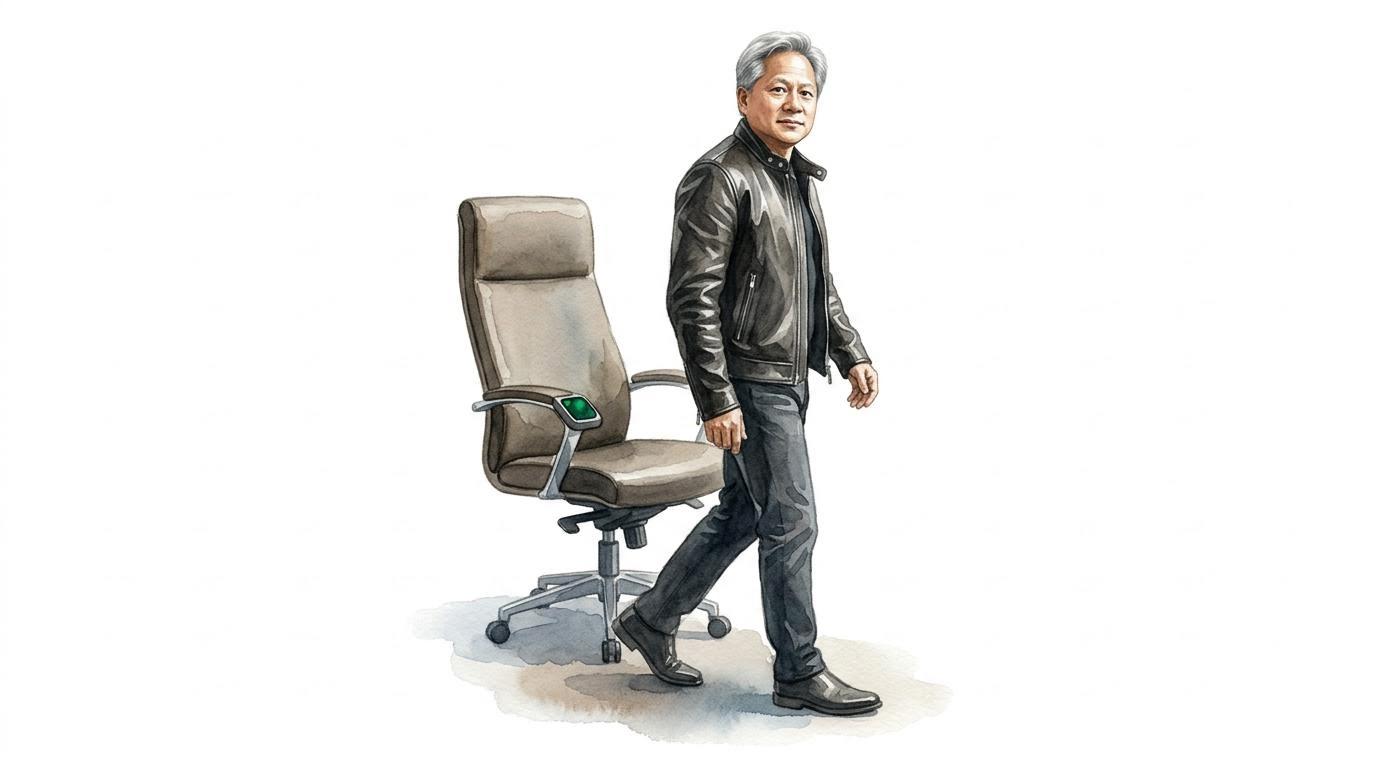
Nvidia’s Sudden Leadership Shake-Up

Nvidia’s Sudden Leadership Shake-Up

Today’s Overview

Good morning, Nvidia’s abrupt CEO change lands alongside a sharp share-price slide, while Google is pitching Gemini 4 Hydrogen as a faster model for everyday coding and agent work. Researchers also say model weights may reveal which advanced chips helped initialize several Chinese AI systems, though the evidence can’t show where those chips were or whether rules were broken. Let’s dive in.

Top Stories

Nvidia CEO Jensen Huang Resigns

Nvidia said Jensen Huang resigned as CEO and from the board, with CFO Colette Kress stepping in as interim CEO and Harvey Jones becoming its first board chair. The move followed reports of relationships with employees and a board investigation; Nvidia shares fell as much as 13% on Thursday, and the company had lost $1.76 trillion in value since its October peak.

  • Kress joined Nvidia in September 2013 and previously spent nearly 25 years in finance roles, including at Cisco and Microsoft.
  • The board will consider internal and external candidates in its search for a permanent CEO.
  • Nvidia’s third-quarter fiscal 2027 results remain scheduled for November 17, followed by an earnings call at 2 p.m. PT.

Claude Meetings

Claude Meetings brings the assistant into the meeting workflow. Users can add Claude to calls and get work started while the conversation is underway.

  • Users can add Claude to calls.
  • The feature is designed to get work underway while participants talk.
  • Its focus is assistance during meetings.

Google Introduces Gemini 4 Hydrogen

Google introduced Gemini 4 Hydrogen, a fast, efficient model aimed at coding and agentic workflows. It scored 51 on the Artificial Analysis Intelligence Index, ahead of Gemini 4 Argon, and costs $1.50 per million input tokens and $7.50 per million output tokens. The model is rolling out across Google’s developer, enterprise and consumer products.

  • In Google Antigravity, Orchestrator reached near-Carbon success rates while using 24% less quota and finishing 19% faster on Terminal-Bench 4.0.
  • Compared with Gemini 3.8 Flash, Hydrogen finished tasks 2.5 times faster and scored 57% versus 18.2% on Terminal-Bench 4.1.
  • On agentic safety evaluations, Hydrogen reduced overreach by up to 81% and was more than 2.3 times as resilient to indirect prompt injection attacks.

Research & Analysis

GSTAR Speeds Up Compressed Image Generation

GSTAR uses spatial and group co-scaling to make discrete autoregressive image generation faster without sacrificing representation quality. Its models performed competitively across five text-to-image benchmarks, and generated a 1024-by-1024 image in 2.5 seconds on one NVIDIA H200, a reported 20-fold speedup over prior discrete autoregressive models.

  • Packing each 2-by-2 neighborhood from the native 32× grid creates an effective 64× interface and cuts global steps by a factor of four.
  • The co-scaling rule preserves a fixed nominal information budget as spatial compression increases; the paper distinguishes this budget from empirical entropy.
  • A fully causal head models code dependencies but adds serial work, while fully parallel prediction can create incompatible code combinations. GSTAR’s decoder uses parallel features with lightweight causal modeling to balance those trade-offs.

SO-Arena Tests Model Reliability Beyond Accuracy

SO-Arena evaluates the capabilities and decision reliability of System One models across 11 domains and five capability families. In tests of 21 models, the researchers found that scaling and extra reasoning helped unevenly across domains, and that strong overall performance did not guarantee reliable decisions.

  • The benchmark contains 2,919 tasks, including 2,300 static tasks and 619 environment-based tasks.
  • Its task pool draws on 40 public sources, with reference labels manually checked against the information available to each model.
  • For stability testing, models face each item in its original order and 12 option reorderings, alongside a separate test that removes the correct answer.

Model Weights Point to Blackwell Hardware Access

A forensic analysis of published model weights found numerical fingerprints consistent with Blackwell initialization in six models from DeepSeek, Moonshot AI, MiniMax and Ant Group. The authors say the fingerprints support, but do not prove, that Blackwell hardware was used for training; they do not establish where the chips were, how access was obtained, or whether export controls were violated.

  • DeepSeek-V4-Flash and MiniMax-M3 matched the 148-SM Blackwell layout, while the other four models matched a 152-SM layout.
  • The method agreed with public hardware disclosures for all 24 models checked against known cases.
  • The analysis estimates Kimi K3’s run used about 4,500 Blackwell GPUs, though the authors emphasize that GPU-count estimates depend on assumptions about training duration and efficiency.

PhysLoop Builds Physical Checks Into Video Generation

PhysLoop uses an LLM-guided, simulator-constrained process to generate, assess and repair videos with more physically consistent behavior. The researchers release 100,000 videos, generation tools, and the PhysLoop-Gen and PhysLoop-Repair evaluation sets. The framework supports both controllable training-data construction and localized video repair.

  • The system uses Unreal Engine as its primary simulator, with Taichi and Genesis also supported.
  • For repair, it replaces only the selected video interval, leaving frames outside that interval unchanged.
  • Simulation renders retain synchronized depth, segmentation and object-state annotations, which are kept separate because they are not pixel-aligned to refined videos.

Trending AI Tools

  • Perplexity Decider v1.3 Updated Decider and Decider Flash models improve classification across text and vision tasks and add selected-content highlighting for extraction.

  • Self-hosted Claude Managed Agents A private beta lets developers run agent services, sandboxes, credential handling and session history within their own infrastructure.

  • A2UI 1.0 The open generative UI protocol offers renderer SDKs for web, Android and iOS, plus agent SDKs for Python, TypeScript and Dart.

Quick Hits

Keep reading for free

Enter your email. If you're already subscribed, we'll send a sign-in code. If not, you'll subscribe in the next step.

Free access. Subscribe once, then use the same email on future issues.

Free to read. Subscription just unlocks the full issue.