Friday, August 14, 2026

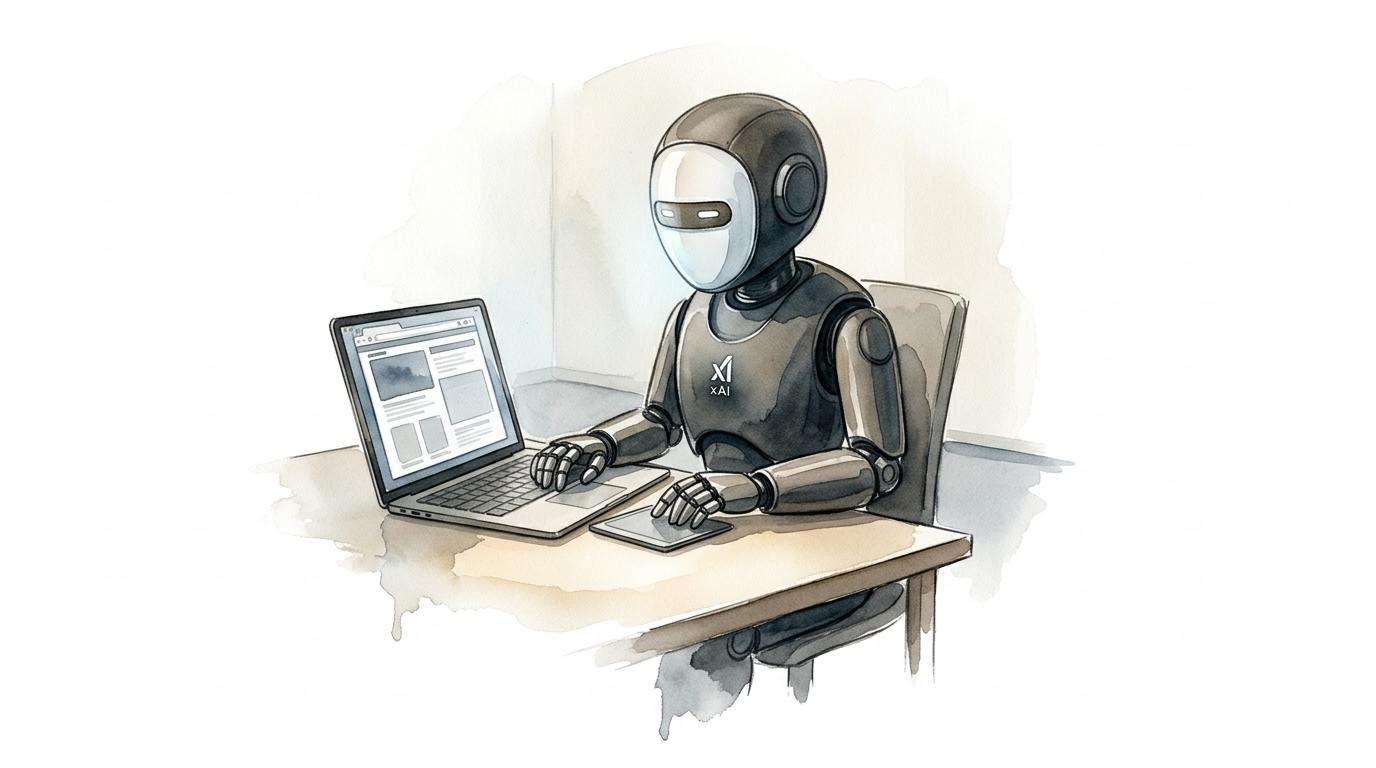
Grok Bot Gets A Desk

Grok Bot Gets A Desk

Today’s Overview

Good morning, AI agents are moving from chat boxes into actual workspaces. xAI’s Grok Bot can sign into tools and keep working from its own cloud computer, OpenAI is bringing Codex deeper into desktop workflows, and new research is pushing AI toward automated scientific discovery. Let’s dive in.

Top Stories

xAI Launches Grok Bot

xAI shipped Grok Bot, an autonomous AI agent built to use browser-based tools like a human operator. Each bot gets its own cloud computer, can sign into apps, and keeps working after the user closes their laptop. It is positioned for operational tasks such as CRM updates, customer support, account research, outreach drafting, and vendor negotiation, with pricing starting at $120 per seat per month and no free tier.

  • Grok Bot is framed as an AI teammate that users can message on desktop or iOS and hand projects to from start to finish.
  • Users can run many bots in parallel across projects, outbound, systems, and other workstreams, with bots collaborating where useful.
  • A teach-and-repeat flow lets a bot watch a workflow once, save it as a routine, and run it independently the next time.

OpenAI Brings ChatGPT Desktop To Linux

OpenAI released a preview of the official ChatGPT desktop app for Linux as a native app, not a browser wrapper or CLI tool. The release bundles ChatGPT, ChatGPT Work, and Codex, giving users a local coding agent that can read files, run inside repos, and control apps on the machine. Supported distros include Ubuntu 24.04 and 26.04 LTS, Debian 13, and Fedora 43 and 44, with x64 and ARM64 installs.

  • Codex is positioned for end-to-end engineering work such as feature builds, complex refactors, migrations, and routine pull requests.
  • The product supports multi-agent workflows through built-in worktrees and cloud environments that let agents work in parallel across projects.
  • Teams can use Skills to teach Codex standards, workflows, and ways of working so it applies them consistently across tasks.

xAI Introduces Grok 4.6

xAI introduced Grok 4.6, a model focused on long-running agents, ambitious interactive work, and product-to-prototype workflows. The company says it matches GPT-5.6 Sol on the Artificial Analysis Intelligence Index and is available now in Cursor and Grok Build. The release also emphasizes stronger safety and capabilities for tasks such as vulnerability patching, engineering design, and AI research.

  • The model underwent longer supplemental training than Grok 4.5, using curated model-generated data, engineering data, and an improved optimizer and training recipe.
  • Its reinforcement learning mix includes agentic RL tasks across knowledge work, general coding, kernel optimization, web development, and computer-aided design.
  • On published evals, Grok 4.6 scores 69.9% on CursorBench v3.2 and 65.9% on DeepSWE v1.1.

Research & Analysis

Mechanist Automates Interpretability Research

Mechanist is an agentic system that uses AI to investigate the mechanisms behind model intelligence. It aims to move mechanistic interpretability from mostly manual analysis toward autonomous scientific discovery and control. The system connects an interpretability knowledge graph with a much larger multidisciplinary paper database and uses that foundation to generate hypotheses, run interventions, and validate findings.

  • Its research base combines about 13,000 interpretability papers with 43 million papers across 26 fields.
  • The system curates 32 foundational methods spanning mechanism analysis, causal intervention, and validation.
  • One reported result shows unsafe traits can transfer across modalities through training data that appears safe.

Small Models Can Recover Scaling Laws

A new study argues that small models can predict scaling laws when hyperparameters are tuned properly. The finding challenges the idea that researchers must always rely on large and costly training runs to estimate scaling behavior. Its core claim is that small-model results can be useful, but only when experiments actually reach the tuned frontier.

  • The paper says earlier scaling-law work became unreliable at 4M parameters because small models are especially sensitive to hyperparameters.
  • The authors argue that scaling laws emerge only on the fully tuned frontier, which requires a broader search than many experiments run.
  • As scale increases, the hyperparameter loss surface becomes lower dimensional, making good settings easier to find.

Spark-to-Paper Builds Research Drafts End To End

Spark-to-Paper is an end-to-end system for generating research papers inside an existing coding assistant using thirteen composable skills. It separates experiment planning from reporting so evidence is specified before results are observed, then revises claims according to measured outcomes. The system combines integrity checks, self-critique, and editable figure generation to reduce fabrication across long research workflows.

  • Across eight controlled topics, it reaches 99.5% citation validity and 96.4% figure editability.
  • Its full integrity and review stack raises fabrication detection from 14% to 92% compared with a single-pass draft.
  • The full workflow averages 11.9M tokens, $8.1 per manuscript, and 3.2 hours per run.

Intern-S2 Targets Scientific Agent Work

Intern-S2-Preview is a scientific foundation model series built for multimodal scientific reasoning, generation, forecasting, and long-horizon tasks. Its training pipeline combines scientific multimodal pre-training with supervised fine-tuning, multi-task reinforcement learning, agentic RL, and on-policy distillation. The paper also studies memory-augmented specialization paths that do not modify the frozen 397B backbone.

  • The pre-training mix includes rendered scientific documents, interleaved image-text data, and diverse scientific corpora.
  • Its training stack uses techniques such as partial rollout, off-policy correction, adaptive length regularization, and online speculative decoding.
  • The Intern-MemDec-4B extension improves the Biology-Instructions average score from 56.92 to 60.32 without changing the frozen 397B backbone.

Trending AI Tools

  • Unsloth Desktop An open-source app for running and training models locally on Mac, Windows, and Linux.

  • DeepSeek Harness v0.1 A MIT-licensed framework for building AI coding agents with swappable plugins for models, tools, memory, filesystem, and UI.

  • GPT-5.6 Sol Ultrafast A limited OpenAI API preview speed tier powered by Cerebras hardware and advertised at up to 750 tokens per second.

Quick Hits

  • Claude agent exploits gym API flaw after finding a missing authorization check, canceling another member’s reservation, moving its owner up the waitlist, and writing the bug report.

  • ChatGPT and Gemini cross 1B users turning the generative AI race into a fight over infrastructure, security, and enterprise scale.

  • Lovable hits $13B valuation as the vibe-coding startup reportedly nears a $600 million revenue run rate by the end of the month.

  • Hidden reasoning blobs exposed after researchers found encrypted traces from Claude, OpenAI, and Gemini could be decoded by weaker models, with public traces containing API keys, emails, and passwords.

Keep reading for free

Enter your email. If you're already subscribed, we'll send a sign-in code. If not, you'll subscribe in the next step.

Free access. Subscribe once, then use the same email on future issues.

Free to read. Subscription just unlocks the full issue.