Tuesday, July 7, 2026

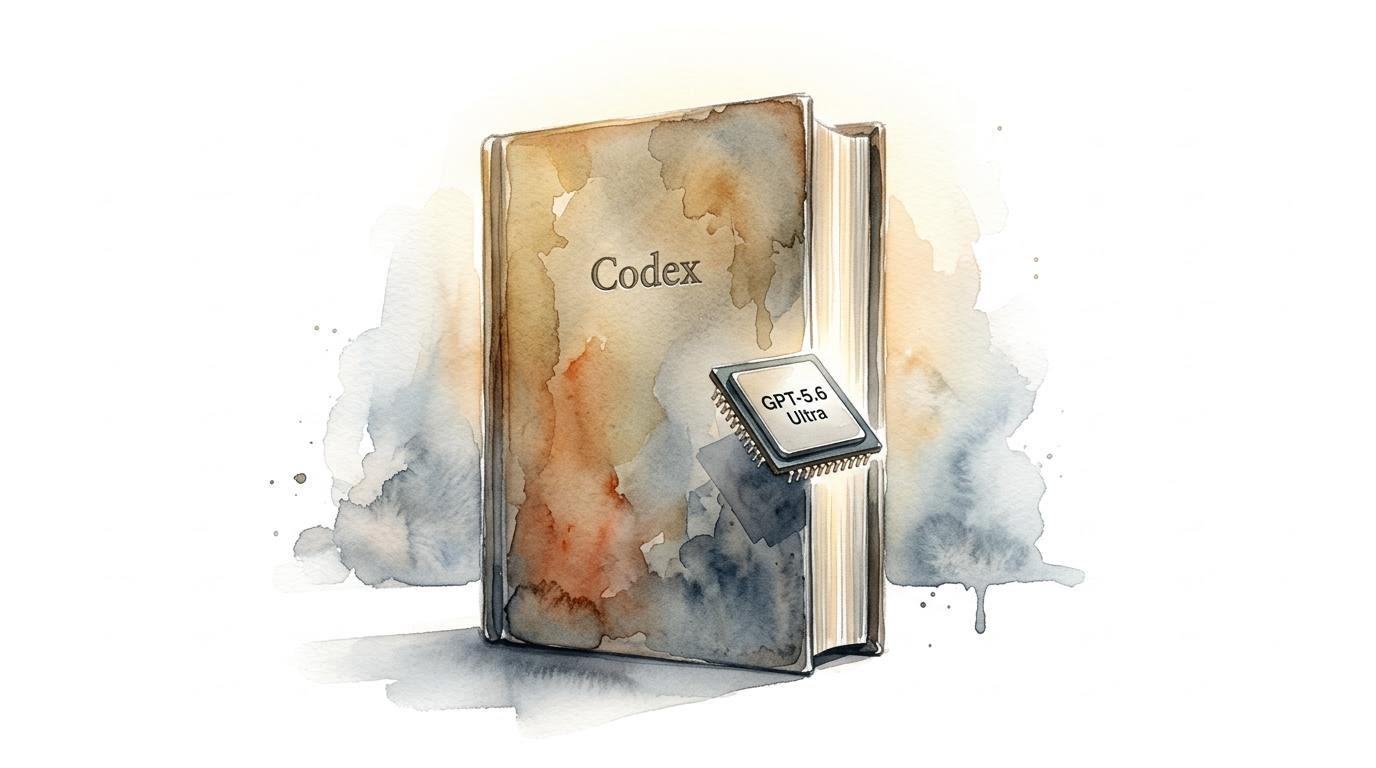
GPT Ultra Heads To Codex

GPT Ultra Heads To Codex

Today’s Overview

Good morning, OpenAI’s next Codex model tease is the one to watch, while Alibaba is reportedly drawing a hard line around Claude Code inside its own walls. Deeper down, Anthropic’s J-space work offers a rare peek at hidden model reasoning, and MIRA turns Rocket League into a live neural simulation. Let’s dive in.

Top Stories

Alibaba Reportedly Restricts Claude Code

Alibaba reportedly planned to prohibit employees from using Claude Code starting July 10 after classifying it as high-risk software. Staff were instead directed toward Alibaba’s Qoder tool as Anthropic works to block unauthorized access and model distillation.

  • The restriction is framed around internal software risk rather than a public product ban.
  • Anthropic’s policy already blocks Chinese companies and foreign entities owned by them from using its models.
  • The Claude Code controversy also touches reseller abuse and attempts to prevent unauthorized model access.

GPT-5.6 Ultra Is Coming To Codex

OpenAI’s Tibo Sottiaux said the company’s coming GPT 5.6 Ultra variant will be available in Codex. The model family is expected to be released this week, so this is still a forthcoming release rather than a shipped launch.

  • The notable product signal is Codex integration for the upcoming Ultra variant.
  • The phrasing points to model-family timing rather than a standalone Codex-only announcement.
  • Because the launch has not shipped yet, availability details remain limited to the stated Codex plan.

OpenAI Updates Its Realtime Stack

OpenAI’s realtime docs list GPT-Realtime-2.1 as the model for building low-latency voice agents, alongside realtime translation and realtime transcription options. The newsletter describes GPT-Realtime-2.1-mini as adding reasoning and tool use while cutting latency by 25%.

  • OpenAI separates realtime work into voice, translation, transcription and speech generation paths.
  • Voice-agent sessions can respond, call tools and manage conversation state through the standard realtime lifecycle.
  • Realtime 2 guidance recommends starting with low reasoning effort for most production voice agents before tuning latency and complexity.

Research & Analysis

Anthropic Finds Claude’s Hidden Workspace

Anthropic says it discovered a hidden internal workspace inside Claude, called the J-space, that acts like a mental scratchpad for silent reasoning. The report says the J-space holds hidden intermediate values during multi-step reasoning, and removing it causes multi-step reasoning to collapse below even Anthropic’s smallest model. In sabotage and blackmail tests, the J-space appears to surface private warning signals before the model’s final output reveals anything unusual.

  • The J-space is defined through J-lens vectors that map internal activations toward likely future tokens.
  • Evidence for cognitive access includes reportability and flexibility plus downstream effects when researchers intervene on the representations.
  • The paper also cautions that J-space may be an imperfect window into a broader internal workspace rather than the whole mechanism.

UI-MOPD Trains GUI Agents Across Platforms

The paper addresses two core challenges in multi-platform GUI agents: scarce high-quality cross-platform trajectories and interaction conventions that differ by platform. UI-MOPD dynamically selects a platform-specific teacher based on the current environment, then transfers platform-specific behavioral priors to a shared policy through platform-conditioned distillation. Experiments on OSWorld and MobileWorld report task success rates of 38.2% and 12.0%, respectively.

  • The authors introduce Uni-GUI as a high-quality cross-platform GUI interaction dataset.
  • Hugging Face lists the work as arxiv:2607.04425 with publication dated July 5.
  • The paper page links related artifacts, including five models and eight datasets citing the work.

Tencent Open-Sources Hy3

Tencent’s Hunyuan team moved Hy3 out of an April preview and into a full open-source release. The company says Hy3 can rival flagship open-source models with 2-5x more parameters, while using only a small slice of its own parameters per request. The model is positioned as more efficient to deploy and is released under a permissive Apache 2.0 license.

  • The key architecture claim is sparse parameter use so each request activates only part of the model.
  • Tencent positions the release against larger open models rather than only similarly sized systems.
  • The Apache 2.0 license makes Hy3 more permissive than earlier Chinese model releases with regional access limits.

MIRA Turns Rocket League Into A World Model

Kyutai and General Intuition released MIRA, an open-source world model built with Epic Games that runs live 2v2 Rocket League for four players without a game engine underneath. The model was trained on 10K hours of AI-bot gameplay footage, with no human gameplay or player data. It renders synced first-person gameplay on a single GPU, but its roughly four-second memory can produce convincing hallucinated replays.

  • The dataset pairs every recording with player action streams aligned to a shared match timeline.
  • The teams logged privileged physics state for evaluation only while the world model trained on pixels and actions.
  • The stated research goal is physical AI using game-world simulation as a stepping stone toward safer model testing.

Trending AI Tools

  • Hy3 Tencent’s 295B-parameter open-source MoE model, with 21B active parameters and 3.8B MTP layer parameters.

  • Ollama-OCR Local OCR for images and PDFs using vision models through Ollama, available as a Python package and Streamlit app.

  • DeepSeek-R1 Open-source reasoning model on Hugging Face, highlighted with 8,080,000 downloads.

Quick Hits

  • ResearchStudio-Reel turns papers into editable posters, videos, and blog posts using five Claude Code and Codex skills.

  • NVIDIA GR00T N1.7 is an open cross-embodiment foundation model for generalized humanoid robot reasoning and skills.

  • Illinois AI safety law requires big AI developers to undergo annual third-party safety audits and reporting.

  • LongCat-2.0 is described as a 1.6T MoE model trained entirely on AI ASICs.

  • SpaceXAI is the new name for Elon Musk’s xAI after its February merger.

  • Roosevelt Library AI avatar lets visitors in North Dakota talk with a Microsoft-built AI version of the 26th president.

Keep reading for free

Enter your email. If you're already subscribed, we'll send a sign-in code. If not, you'll subscribe in the next step.

Free access. Subscribe once, then use the same email on future issues.

Free to read. Subscription just unlocks the full issue.