Tuesday, June 30, 2026

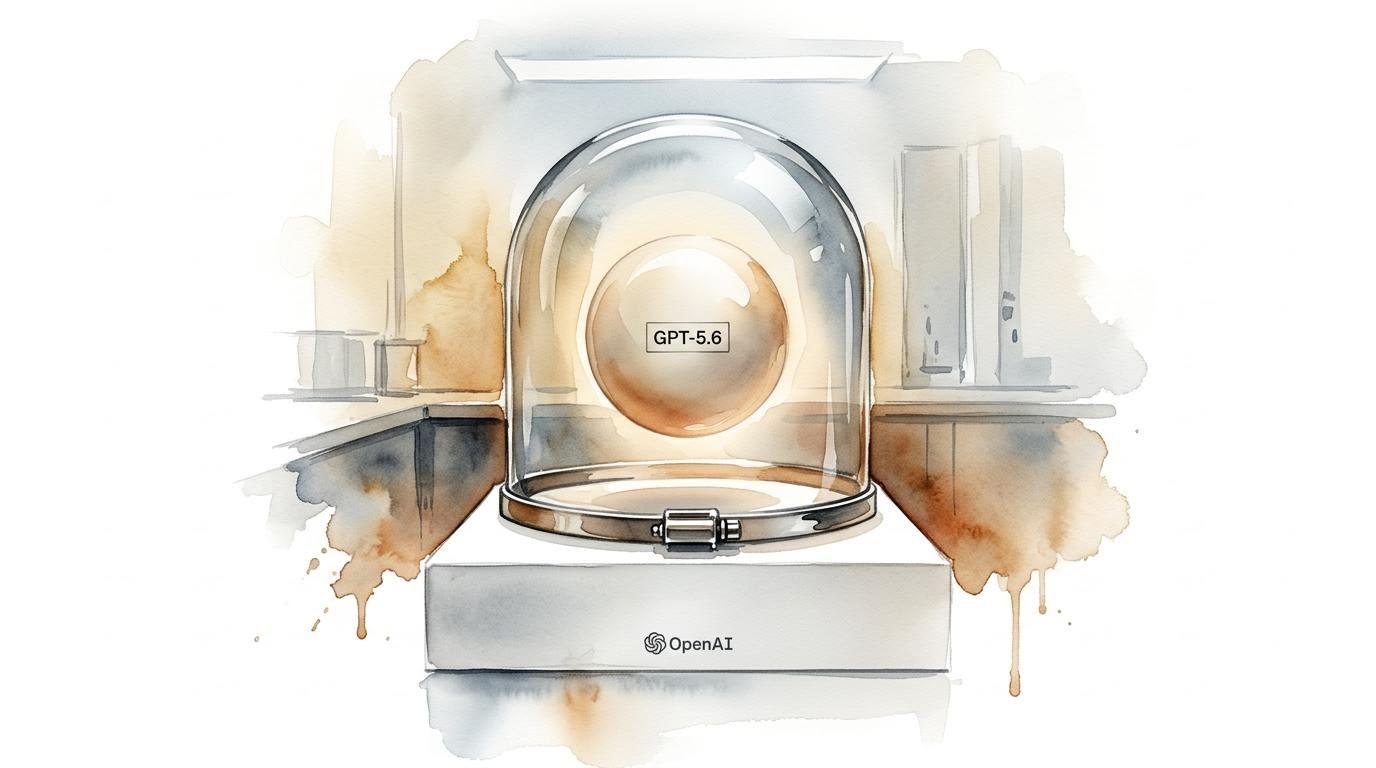
GPT-5.6 Gets a Guarded Debut

GPT-5.6 Gets a Guarded Debut

Today’s Overview

Good morning, AI’s power bottlenecks are getting very real: Google reportedly throttled Meta’s Gemini access, while OpenAI’s GPT-5.6 preview arrives with a heavier safety regime. Europe is also asking whether frontier AI access should depend so much on U.S. decisions. Let’s dive in.

Top Stories

OpenAI previews GPT-5.6 family

OpenAI introduced GPT-5.6 Preview, a model family named Sol, Terra, and Luna, with Sol positioned as the flagship. The system card frames the launch as a limited preview before broader availability, with stronger cyber and bio safety testing and new safeguards in place.

  • The model lineup includes three tiers: Sol as the flagship, Terra as a lower-cost option, and Luna as the fastest, most cost-efficient model.
  • OpenAI classifies Sol, Terra, and Luna as High capability in both cybersecurity and biological and chemical risk under its Preparedness Framework.
  • The safety work includes 700,000 A100e GPU hours dedicated to automated jailbreak discovery, with continuous red teaming planned during deployment.

Google reportedly capped Meta’s Gemini usage

Google reportedly limited Meta’s use of Gemini after Meta sought more AI compute capacity than Google could provide. The reported cap delayed some of Meta’s internal projects and shows that even the largest AI companies are running into infrastructure constraints.

  • The reported trigger was compute demand from Meta that exceeded what Google could supply for Gemini access.
  • Meta reportedly responded by telling staff to use AI tokens more efficiently as the restrictions stayed in place.
  • The story points to a broader constraint: capacity, not just model quality is becoming a competitive variable in frontier AI partnerships.

Austria pushes EU to host Anthropic

Austria is reportedly urging the EU to consider hosting Anthropic after U.S. restrictions limited access to the company’s most advanced models. The push fits into Europe’s wider AI sovereignty debate, alongside domestic model efforts and renewed attention to chip independence.

  • Austria’s proposal aims to counter foreign access curbs that restricted use of Anthropic’s most advanced models outside the United States.
  • The reported pitch centers on giving Anthropic legal certainty and market access inside the European Union.
  • The move reflects Europe’s concern that frontier model availability can be shaped by U.S. national security decisions.

Research & Analysis

Reward models can be too sensitive

Meta studied how reward models can overreact to equally good responses, nudging reinforcement learning toward reward hacking. The paper proposes evaluating reward models through discriminative ability and specificity, then using Monte Carlo dropout to cluster continuous rewards into safer discrete signals.

  • The paper argues that continuous rewards can turn a seeming strength into oversensitivity when models assign different scores to responses that are equally good.
  • The authors separate reward quality into discriminative ability and specificity instead of relying on a single accuracy-style metric.
  • Their proposed method is training-free and can be applied to neural reward models using Monte Carlo dropout.

Qwen Image Agent introduces IA-Bench

Qwen-Image-Agent improves text-to-image generation by adding planning, reasoning, search, memory, and feedback to fill in missing user context. The work also introduces IA-Bench to evaluate agentic image generation across those capabilities.

  • The paper defines the core problem as the Context Gap: the mismatch between what a user provides and what a text-to-image model needs to generate well.
  • Its context-building process uses Context-Aware Planning to identify missing information and decide how that information should be acquired.
  • The benchmark tests four core agent skills: Plan, Reason, Search, and Memory across agentic image generation tasks.

Google speeds up Gemini Nano on Pixel

Google described a new architecture that retrofits Multi-Token Prediction onto existing frozen Gemini Nano v3 models. The work targets mobile deployment limits, where energy, RAM, and latency constraints make efficient on-device inference especially difficult.

  • The approach has rolled out to Pixel 9 and 10 devices for features such as AI Notification Summaries and Proofread.
  • Google says the frozen backbone preserves base model capabilities because the efficiency update trains only the attached MTP head.
  • A zero-copy design cuts memory use by up to 130MB compared with a standalone drafter by reusing the main model’s KV cache.

Trending AI Tools

  • NotebookLM Collections Google is testing a way to organize multiple notebooks under one heading.

  • PMB Local-first memory for AI coding agents, aimed at reducing repeated project context setup.

  • Receiptor AI Agent Mode A bookkeeping assistant designed to run receipt workflows end to end.

Quick Hits

  • AI economy hit $110B with Exponential View research saying generative AI revenue is on track for $175 billion and scaling faster than prior technologies.

  • Anthropic Economic Index finds AI computational costs strongly correlate with task value, with higher-wage occupations using up to 2.5 times more tokens.

  • Free agentic AI book offers a technical resource on the full stack of building agentic AI systems.

Keep reading for free

Enter your email. If you're already subscribed, we'll send a sign-in code. If not, you'll subscribe in the next step.

Free access. Subscribe once, then use the same email on future issues.

Free to read. Subscription just unlocks the full issue.