Monday, July 13, 2026

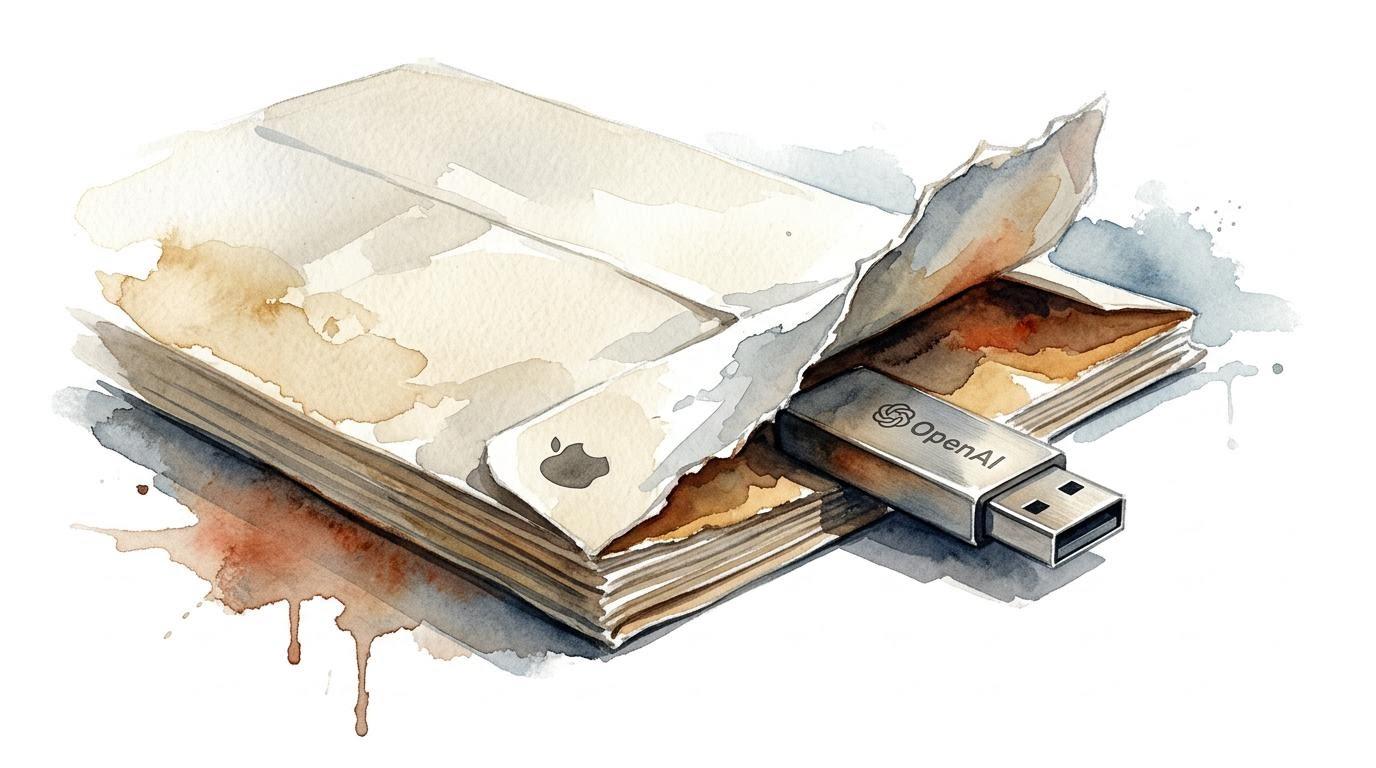
Apple Takes OpenAI To Court

Apple Takes OpenAI To Court

Today’s Overview

Good morning, Apple just escalated the AI hardware race with a lawsuit against OpenAI, while OpenAI is flooding the zone with GPT-5.6 and a new work agent for teams. Researchers are also pushing a bigger idea: video generators and visual documents may become core training fuel for smarter AI systems. Let's dive in.

Top Stories

OpenAI Ships GPT-5.6, GPT-Live, And ChatGPT Work

OpenAI shipped three launches in three days: the GPT-5.6 model family, GPT-Live voice models, and ChatGPT Work. The release expands OpenAI’s model lineup while pushing ChatGPT further into voice, apps, files, and longer-running agentic work.

  • The new family includes Sol, Terra, and Luna, with Sol positioned as the flagship, Terra as the balanced everyday model, and Luna as the most cost-efficient option.
  • For hard tasks, ultra mode coordinates multiple agents across parallel workstreams instead of relying on a single reasoning path.
  • OpenAI says GPT-5.6 Sol reached 92.2% on BrowseComp and 62.6% on OSWorld 2.0, tying the launch directly to web browsing and computer-use performance.

ChatGPT Work Turns Team Context Into Finished Work

ChatGPT Work is a GPT-5.6-powered workspace that gathers context from team tools and acts across files and desktop applications. It is designed to turn scattered project materials into finished documents, spreadsheets, and presentations.

  • OpenAI says ChatGPT Work is available on desktop today and will roll out to Plus, Pro, Business, Enterprise, and Edu users on web and mobile over the next few days.
  • The workspace is aimed at teams in finance, ops, marketing, sales, data, and engineering, with examples centered on analysis, forecasts, dashboards, and executive-ready presentations.
  • The product is powered by GPT-5.6 Sol, Terra, or Luna, which OpenAI frames as models that can navigate ambiguity and deliver polished outputs with less prompting.

Apple Sues OpenAI Over Trade Secret Claims

Apple accused OpenAI and former Apple executives of stealing confidential hardware information to support OpenAI’s device ambitions. The lawsuit alleges that senior leaders directed employees to bypass security procedures and transfer sensitive product details.

  • The case was filed in U.S. District Court for the Northern District of California on Friday, July 10, 2026.
  • Apple’s complaint names Tang Tan, a former Apple VP of product design for iPhone and Apple Watch who later became OpenAI’s chief hardware officer.
  • The suit also references Chang Liu, a former Apple senior systems electrical engineer accused of failing to return an Apple laptop and downloading confidential technical documents.

Research & Analysis

Video Generators Become Vision Learners

Google DeepMind researchers argue that large-scale text-to-video generation is a strong pretraining paradigm for computer vision. Their GenCeption model uses a pretrained video diffusion backbone to create a feed-forward perception model guided by text instructions.

  • The paper was published on July 10, 2026 and listed on Hugging Face as the number 3 paper of the day.
  • The author list includes Kaiming He alongside Letian Wang, Chuhan Zhang, Rishabh Kabra, Andrew Zisserman, Joao Carreira, and others.
  • The authors frame text-to-video pretraining as a way to combine spatiotemporal priors, vision-language alignment, and scalability for general visual intelligence.

GPT-5.6 Sol Ultra Tackles A 50-Year Math Problem

GPT-5.6 Sol Ultra reportedly produced a proof of the Cycle Double Cover Conjecture in under one hour using 64 subagents in parallel. OpenAI published the full prompt, proof PDF, and Lean formalization, though the proof has not yet been peer-reviewed.

  • The repository says the formalization kernel-checks finite loopless bridgeless multigraphs and ends at CDCLean.cycleDoubleCover_of_bridgeless in CDCLean/Main.lean.
  • The Lean setup is pinned to Lean v4.31.0 and Mathlib revision 9a9483a92959bc92bd6a60176dd1fe597298c1f8.
  • The audit instructions scan for sorry, admit, native_decide, axiom, opaque, and unsafe, with the expected audit listing only propext, Classical.choice, and Quot.sound.

Visual Pretraining Challenges Text-Only Learning

Researchers report that unsupervised visual pretraining on documents and web pages can outperform text-only pretraining for foundation models. The work challenges the assumption that language models should learn primarily from extracted text.

  • The paper was published on July 10, 2026 and listed on Hugging Face as the number 2 paper of the day.
  • Its authors argue that figures, equations, and layouts carry knowledge that plain-text conversion can fail to capture faithfully or completely.
  • The study directly uses visual documents without text extraction, then compares that approach with text-only pretraining on the same underlying corpora.

Kyutai Releases Open Song-To-MIDI Model

Kyutai released an open model for transcribing songs into per-instrument MIDI. The work is positioned as a technical music transcription system for complex, real-world music recordings.

  • The paper is titled MuScriptor and was submitted to arXiv on July 9, 2026.
  • The authors say existing automatic transcription methods often struggle with complex real music mixes or remain limited to single-instrument recordings.
  • The training recipe combines synthetic pretraining, real-audio fine-tuning, and reinforcement learning with conditioning on instrument presence to customize transcriptions.

Trending AI Tools

  • Muse Spark 1.1 Meta released an agentic model for tool and computer use through a new paid Meta Model API.

  • Grok 4.5 SpaceXAI launched a 1.5-trillion parameter model positioned around enterprise utility, speed, and aggressive token pricing.

  • Ship OS Notion introduced an agent-native software shipping workflow inside Notion.

Quick Hits

  • Kimi K2 is an open agentic model from Moonshot AI that has passed 1,040,000 downloads on Hugging Face.

  • Meta Model API opened in public preview alongside Muse Spark 1.1, with improvements across tool use, coding, computer interaction, and multimodal reasoning.

  • OpenAI safety leadership is changing, with Saachi Jain set to serve as interim head of safety systems after Johannes Heidecke’s departure.

  • Meta pulls Muse Image after backlash over a feature that could use content from public-facing accounts to create AI-generated or altered images.

  • OpenAI copyright fight escalated as news organizations accused the company of concealing evidence and misleading the court about searching ChatGPT logs.

  • Meta AI chips are set to begin production in September, with Netta and Broadcom working on design and TSMC handling manufacturing.

Keep reading for free

Enter your email. If you're already subscribed, we'll send a sign-in code. If not, you'll subscribe in the next step.

Free access. Subscribe once, then use the same email on future issues.

Free to read. Subscription just unlocks the full issue.