Tuesday, June 16, 2026

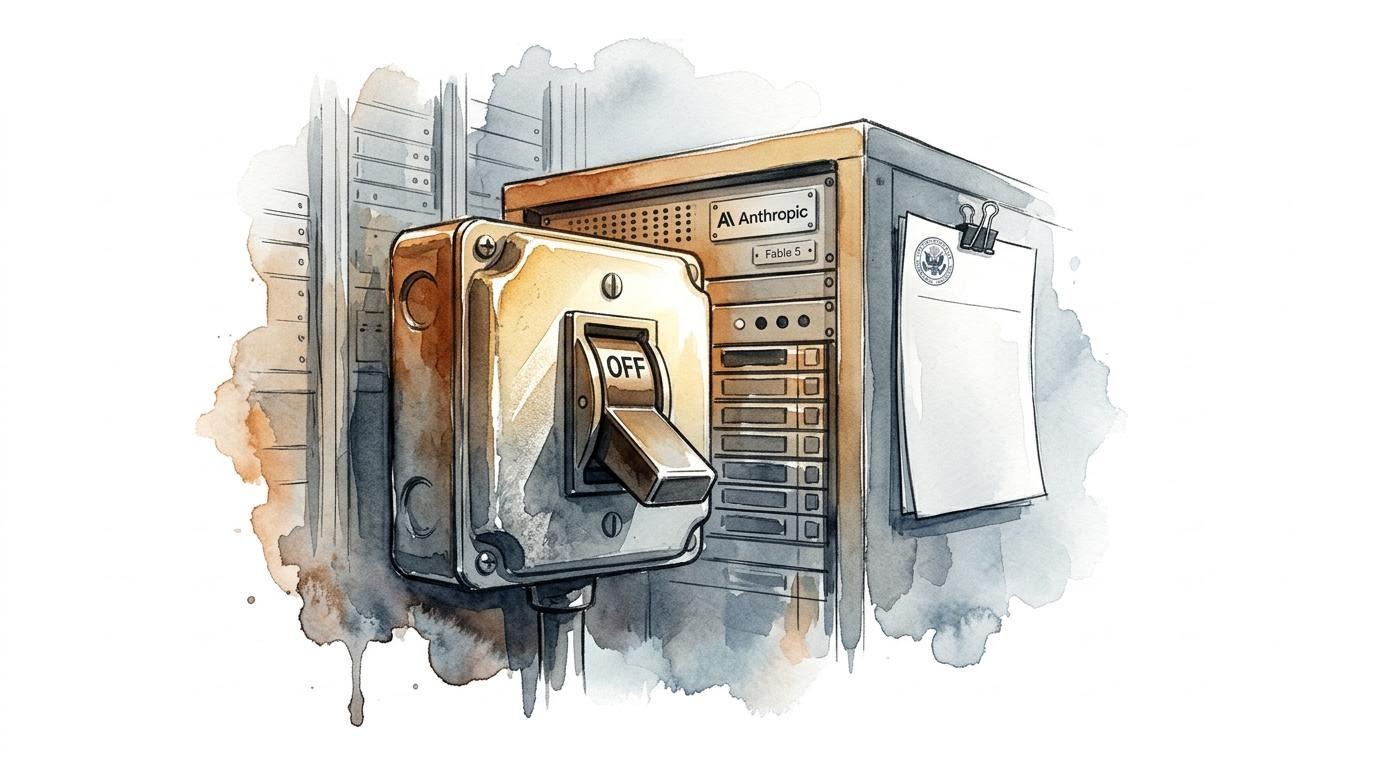
Anthropic’s Fable Fight Gets Real

Anthropic’s Fable Fight Gets Real

Today’s Overview

Good morning, AI’s safety fight just got unusually concrete: Anthropic lost access to two flagship models under a U.S. directive, while cyber leaders are pushing back hard. Meanwhile, DeepMind is sketching the road from AGI to superintelligence, and SpaceX’s mega-IPO is dragging frontier AI exposure into public markets. Let’s dive in.

Top Stories

Anthropic Disables Fable 5 and Mythos 5

Anthropic disabled Fable 5 and Mythos 5 for all users after receiving a U.S. government export-control directive tied to national security concerns. The company said the move was required for compliance and makes both models unavailable while it works to restore access.

  • The directive applied to foreign nationals whether inside or outside the United States, including Anthropic employees.
  • Anthropic said the government’s evidence involved a narrow jailbreak used to identify a small number of previously known, minor vulnerabilities.
  • The company argued that the demonstrated capability was widely available from other publicly available models and used by defenders in everyday security work.

Cyber Leaders Push to Free Fable

More than 100 cybersecurity executives and researchers signed an open letter urging the U.S. to lift its export ban on Anthropic’s Fable 5. The letter argues the restriction weakens defenders without meaningfully slowing attackers who can use comparable capabilities from rival models.

  • The signers frame AI-assisted vulnerability finding as defensive infrastructure that helps teams patch newly written and legacy code faster.
  • The letter says comparable flaw-finding can be replicated on GPT-5.5, Opus, Sonnet, and Kimi 2.7 rather than being unique to Fable.
  • Its policy ask is a process grounded in scientific evaluations with democratic rulemaking, transparent enforcement, and room to remediate.

SpaceX Prices the Largest IPO Ever

SpaceX priced its IPO at $135 per share and began trading on Nasdaq under the ticker SPCX, raising around $75 billion at a valuation near $1.75 trillion. The listing folds in xAI, Grok, and Colossus data centers, giving public investors exposure to a frontier AI lab before expected Anthropic and OpenAI listings.

  • The offering sold about 555.6 million shares at the final $135 IPO price.
  • The deal surpassed Saudi Aramco’s 2019 listing which had previously held the record for the largest IPO.
  • Early trading opened at $150 per share putting the stock above its IPO price at debut.

Research & Analysis

DeepMind Maps Four Routes to Superintelligence

A 60-page DeepMind paper, From AGI to ASI, lays out four routes from human-level AI to superintelligence: scaling, discontinuous algorithmic change, recursive self-improvement, and collective intelligence. The researchers also discuss faithful uncertainty, Open Knowledge Format, and Gemini-SQL2 as part of a broader push to make advanced systems more reliable and useful.

  • The paper says the four routes are largely independent and could progress in parallel rather than as a single sequence.
  • Its scaling section flags uncertainty around whether data and compute can keep expanding fast enough to sustain capability gains.
  • The authors emphasize digital intelligence advantages like copying, pausing, speeding up, and sharing experience as reasons human-based intuitions may break down.

GitHub Opens Multilingual Repository Dataset

GitHub published the GitHub Multilingual Repositories Dataset, a repository-level metadata dataset for finding public repositories with evidence of non-English natural-language content. The release is aimed at researchers and developers building multilingual AI systems.

  • The dataset covers over 80 million classification rows across more than 40 million repositories.
  • GitHub found Korean was most common in issue text while Portuguese led non-English README content with more than 3 million repositories.
  • The release includes classifications from fastText, gcld3, and lingua-py with confidence scores instead of collapsing them into one label.

Nadella Frames AI Moats Around Token Capital

Satya Nadella argues that companies will increasingly build defensible AI moats through proprietary learning loops rather than model choice alone. The framing centers on private evaluation, reinforcement learning, and enterprise-specific knowledge as the source of durable advantage.

  • The strategy separates rented model capability from owned institutional knowledge that can compound inside company workflows.
  • Nadella’s test for control is whether a company can swap models without losing the veteran know-how embedded in its system.
  • Microsoft Research’s Mirage is positioned as an example of efficiency-focused AI using latent spatial memory and a compact latent cache for video consistency.

Nvidia Blackwell Leads Agentic Infrastructure Benchmark

NVIDIA’s Blackwell Ultra NVL72 platform led the AgentPerf benchmark, which measures infrastructure performance for agentic AI workloads. NVIDIA says the system delivered 20x more agent throughput per megawatt than Hopper.

  • AgentPerf is based on real coding agent trajectories including reading files, editing code, executing commands, and iterating on results.
  • The first round used DeepSeek V4 Pro as the large mixture-of-experts model powering the tested workload.
  • GB300 NVL72 links 72 GPUs into a rack-scale system designed to run large MoE models efficiently.

Trending AI Tools

  • Sakana Marlin Autonomous research assistant that turns a topic into a strategy report and summary slides in hours.

  • OpenRouter Fusion API that sends prompts to multiple models, evaluates their answers, and merges them into one response.

  • Facebook AI Mode Meta AI search experience for Facebook content, plus new AI photo, collage, and video editing tools.

Quick Hits

  • AWS WAF AI monetization lets content owners charge AI bots by content path, bot category, or verification tier without changing origin infrastructure or application code.

  • Nadella’s AI moat memo argues that a company’s edge comes from its own learning loop of workflows and judgment, not simply from choosing the strongest model.

  • Salesforce buys Fin for $3.6 billion, adding Fin’s support agents and 30,000 customers to the Agentforce lineup.

  • whoburnedmore is a Spotify Wrapped-style product for Claude and Codex, with a public leaderboard.

  • Cartesia Sonic-3.5 and Ink-2 pair speech generation and transcription models that Cartesia says rank No. 1 on Artificial Analysis leaderboards.

  • China’s university cuts have removed more than 12,000 programs over five years as schools shift away from arts and languages toward tech fields.

Keep reading for free

Enter your email. If you're already subscribed, we'll send a sign-in code. If not, you'll subscribe in the next step.

Free access. Subscribe once, then use the same email on future issues.

Free to read. Subscription just unlocks the full issue.