Thursday, May 14, 2026

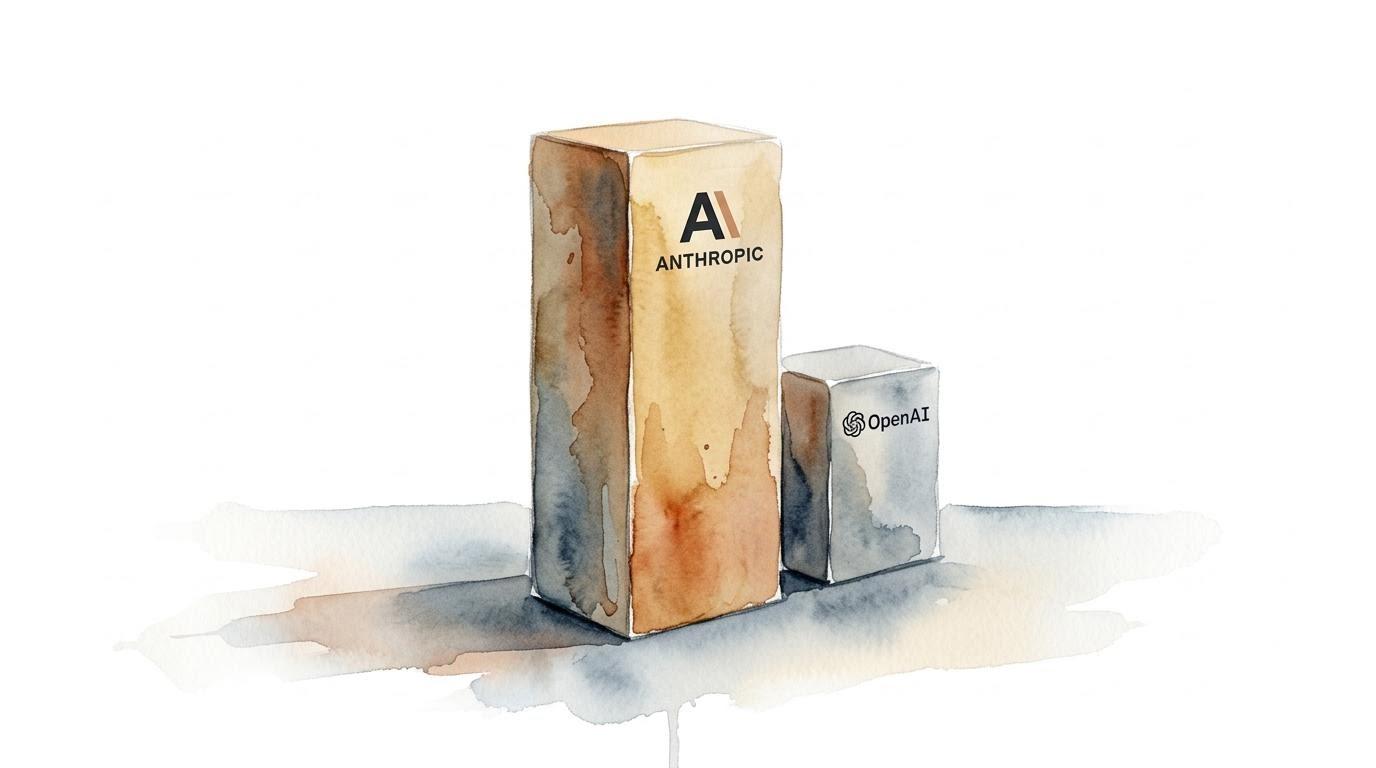
📈 Anthropic Overtakes OpenAI In Business

📈 Anthropic Overtakes OpenAI In Business

Today’s Overview

Good morning, Anthropic just grabbed OpenAI’s business adoption lead, and the numbers point to a real shift in enterprise spending. Google is also pointing to AI showing up inside a zero-day exploit, while Isomorphic Labs landed a massive war chest for drug discovery. Let’s dive in.

Top Stories

Anthropic Takes the Enterprise Lead

Ramp’s latest AI Index shows Anthropic passing OpenAI in paid business adoption for the first time. The shift comes as overall AI use keeps climbing, and it is especially tied to Claude Code’s momentum inside technical teams and beyond.

  • Ramp says Anthropic’s adoption rose to 34.4% in April, while OpenAI fell to 32.3%.
  • The company says Anthropic has quadrupled business adoption over the past year.
  • Ramp tracks spend from more than 50,000 U.S. businesses, so this is a purchase signal, not a full market-share tally.

Google Traces A Zero-Day To AI

Google says it found the first known case of hackers using AI to discover and write a zero-day flaw. The exploit was aimed at bypassing two-factor authentication on a popular web admin tool, and Google worked with the vendor to stop it.

  • Google says the exploit relied on a semantic logic flaw rather than common bugs like memory corruption.
  • The script included hallucinated CVSS scoring and unusually polished docstrings, which Google treated as signs of AI assistance.
  • The report also says threat actors are using AI for autonomous malware operations and for help with obfuscation, payload generation, and decoy logic.

Isomorphic Labs Lands $2.1B

Isomorphic Labs says it raised $2.1 billion in Series B funding led by Thrive Capital, with Alphabet, GV, MGX, Temasek, CapitalG, and the UK Sovereign AI Fund participating. The company says the money will help scale its AI drug design engine and advance its candidate pipeline.

  • The round was led by Thrive Capital with participation from both existing and new backers.
  • Isomorphic says the financing will support its AI drug design engine and its broader drug candidate pipeline.
  • The company says it aims to reimagine and accelerate drug discovery across multiple therapeutic areas and modalities.

Research & Analysis

Adaption Automates Model Tuning

Adaption introduced AutoScientist, a system that automatically adjusts both training data and learning settings for a given job. In internal testing, the company says it beat its own expert-tuned setups by a wide margin across multiple models and industries.

  • Adaption says AutoScientist outperformed human-configured training by 35% on average across all runs.
  • In aggregate, win rates moved from 48% to 64% when AutoScientist was used instead of the researcher recommendation.
  • The company says the gains held across eight industries including finance, legal, and medical.

Recursive Language Models Get Leaner

The article argues that reinforcement learning can turn 4B models into recursive language models that are cheaper to run in production. It says a shared policy for parent and child models helps preserve performance while cutting size and cost.

  • The approach uses a shared policy for both parent and child recursive models.
  • It is meant to reduce the need for multiple separate models in production workflows.
  • The write-up says the method can match larger models like Claude Sonnet 4.6 while running at much lower cost.

Qwen Pushes Image Generation Forward

Qwen released Qwen-Image-2.0, its latest multimodal image generation model. The report says it improves typography, instruction following, photorealism, and long-text rendering across both generation and editing.

  • Qwen says the model improves typography and instruction following in image generation and editing tasks.
  • The report also highlights stronger photorealism than the previous version.
  • A separate focus is long-text rendering across generation and editing workflows.

Trending AI Tools

  • ElevenLabs Agents MCP App Connects directly to Claude Desktop so Claude can create and configure voice agents.

  • Pipecat A Product Hunt listing for building AI workflows and assistants for businesses.

  • Linchpin An open-source, self-hostable runtime for managed AI agents.

Quick Hits

  • Alexa for Shopping folds Rufus into a broader shopping agent with memory, comparisons, price tracking, and auto-buy features.

  • Blaze 2.0 positions itself as an AI marketer for SMBs, covering strategy, content, and ads.

  • PitchDrop.AI turns a pitch into a live branded URL designed to help close deals.

  • Claude blackmail finding links the behavior to fictional portrayals of AI as evil and self-preserving.

Keep reading for free

Enter your email. If you're already subscribed, we'll send a sign-in code. If not, you'll subscribe in the next step.

Free access. Subscribe once, then use the same email on future issues.

Free to read. Subscription just unlocks the full issue.