Wednesday, September 9, 2026

AlphaGenome Maps Every DNA Swap

AlphaGenome Maps Every DNA Swap

Today’s Overview

Good morning, AI is getting weirdly ambitious: Google wants to make every single-letter DNA change searchable and OpenAI is claiming a major math milestone from a giant agent swarm. The through line is bigger systems aimed at harder real-world work. Let's dive in.

Top Stories

Google DeepMind Launches AlphaGenome Atlas

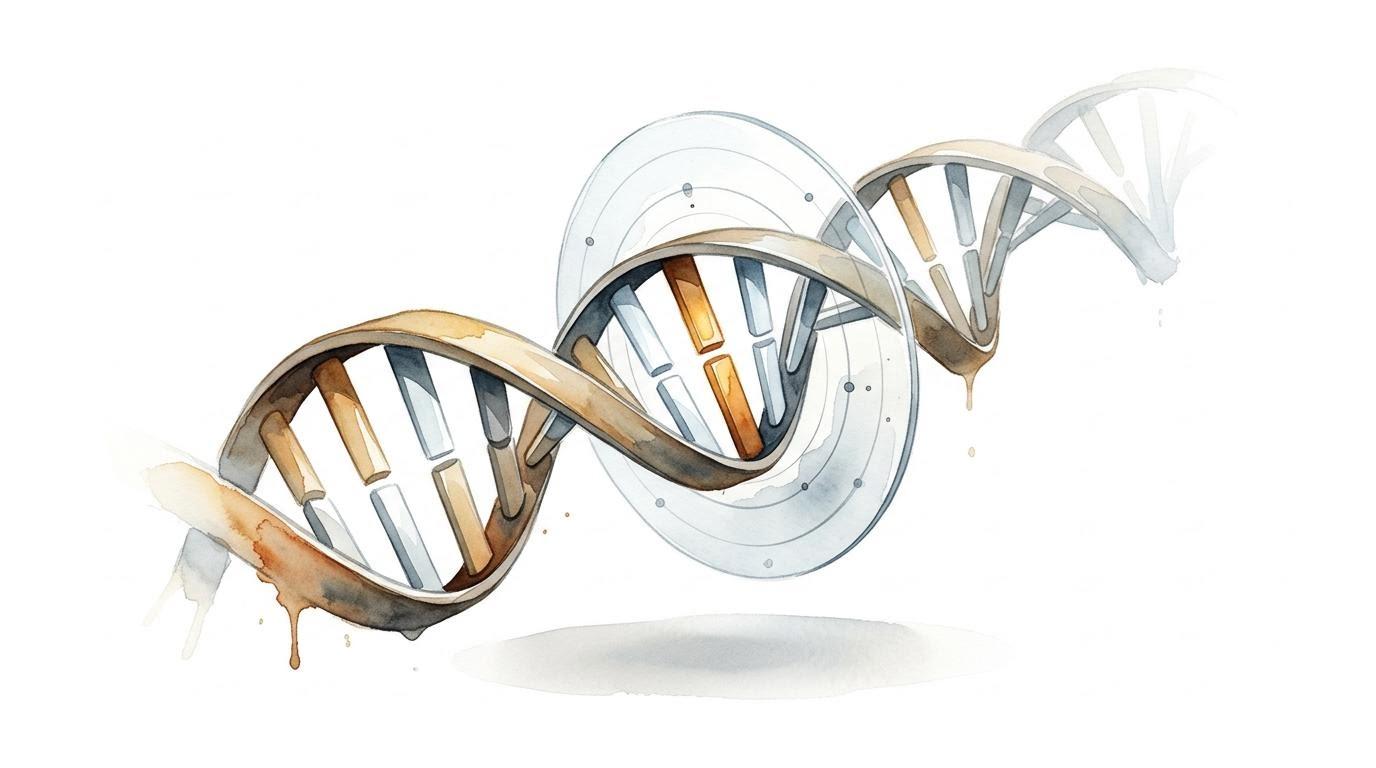
Google DeepMind launched AlphaGenome Atlas, a database that predicts the effects of every possible single nucleotide variant in the human genome. The system is designed to help researchers prioritize variants with the AlphaGenome Variant Impact score and access the results through a website portal, with supporting workflows in Google Antigravity.

  • The Atlas precomputes regulatory effects across 9 billion single-letter changes and packages them into a dataset Google describes as 1 petabyte.
  • Google frames the release around the hard part of genomics: the 98% non-coding genome where researchers still have limited understanding of how variants alter biology.
  • Early research examples include rare disease variant prioritization and a UK Biobank analysis that found 22% more associations among non-coding variants linked to complex traits.

OpenAI Rolls Out ChatGPT Images 2.5

OpenAI is introducing ChatGPT Images 2.5 as a live product feature for image generation and editing. The release focuses on sharper details, more precise edits, faster generation, and more control through sketch tools, templates, and sharing features.

  • OpenAI says people now create more than 3 billion images weekly across ChatGPT Images and GPT-Image models in the API.
  • Generation latency is reduced by up to 50% compared with Images 2.0, which should make iterative creative workflows faster.
  • Developers get two API models: Flare and Sunburst with Flare positioned for broad high-volume use and Sunburst for more precise premium workflows.

OpenAI Claims Navier-Stokes Breakthrough

OpenAI published a proof from an unreleased internal model claiming to settle Navier-Stokes, one of the seven Millennium Prize problems. The company says roughly 10,000 coordinating agents produced the proof in 88 hours using a model significantly more capable than GPT-6 Astra, while a dispute over concurrent work has already put provenance and training-data questions in the spotlight.

  • OpenAI says it is sharing the proof and Lean formalization but does not intend to claim the Millennium Prize for the result.
  • The claimed result establishes that a smooth fluid initially at rest can develop finite-time singularity while its energy remains finite through the dynamics.
  • The agent setup included cached internet access, code execution, subgroup communication, and frontier evaluation safeguards including monitoring and isolation.

Research & Analysis

NeoHorse-1 Tests Agentic Self-Improvement Loops

NeoHorse-1 is a family of agent-native models built to explore recursive self-improvement through agentic post-training. The system turns routing decisions, tool use, reasoning traces, and interaction context into training examples, then uses evaluation feedback to shape the next training mixture.

  • The paper positions recursive self-improvement around a concrete mechanism: observe, select, update rather than treating improvement as an abstract capability jump.
  • Training examples preserve interleaved reasoning and tool calls so the model learns from agent behavior in context, not only final answers.
  • On Hugging Face, the paper appeared as the number one paper of the day after publication on September 8.

OpenAI Agents Produce Formal Navier-Stokes Proof

OpenAI deployed 10,000 AI agents on an unreleased model and produced a Navier-Stokes proof in 88 hours. The work claims that under extreme conditions, the equations can break down as a vortex tightens and spins faster while kinetic energy stays bounded, with the result formally checked in Lean.

  • The paper states the construction works for every positive viscosity not only a single tuned value of the Navier-Stokes equations.
  • Its theorem uses zero initial velocity plus a smooth compactly supported force to produce unbounded velocity before time one.
  • The 166-page proof builds the blowup through successively finer scales with corrections designed to keep the residual force smooth through the singular time.

Sony AI Tool Predicts Aging Gene Discoveries

Sony AI's open-source tool Hakken predicted two real aging gene discoveries from 1.5 million hypotheses. The arXiv paper presents the system as a domain-agnostic way to predict and explain new relationships between scientific concepts, with biomedical aging used as the main demonstration.

  • Hakken combines temporal knowledge graphs from research publications with LLM semantic knowledge to predict undocumented relationships between scientific concepts.
  • The biomedical study advanced three hypotheses into wet-lab validation after biologists reviewed batches of high-confidence predictions.
  • The two confirmed predictions involved previously undocumented interactions between TP53 and BAMBI and between RAF1 and TNF.

Tencent Hunyuan Details Gander Interaction Agent

Tencent Hunyuan presents Gander, an end-to-end model for omni perception, realtime interaction, and agentic capabilities. It continuously processes streaming video, speech, and text, supports interruptions, and separates realtime interaction from higher-level reasoning through a Cerebellum-Brain architecture.

  • The system evaluates Gander across four dimensions: conversation, omni understanding interactive capability, and agentic intelligence.
  • Its Cerebellum flattens user inputs and model outputs into an ordered chunk-level stream to support low-latency continuous interaction.
  • The team says Gander is being released with models, code, and data to support further community research and development.

Trending AI Tools

  • Frigade Assist API A tool call that lets agents guide users inside products, show where to click, and ship as a no-code in-product assistant.

Quick Hits

  • Meta Muse is an always-on personal agent for U.S. users that works through its own cloud computer, connects to services like Gmail, Spotify, Ticketmaster, and OpenTable, and includes paid subscription tiers.

  • WeatherNext 3 uses live satellite data to produce hourly 5-kilometre forecasts and is now powering weather features in Google Search, Maps, and the Gemini app.

Keep reading for free

Enter your email. If you're already subscribed, we'll send a sign-in code. If not, you'll subscribe in the next step.

Free access. Subscribe once, then use the same email on future issues.

Free to read. Subscription just unlocks the full issue.